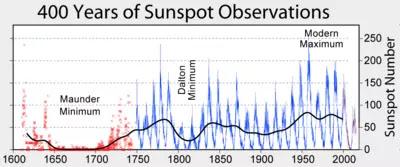
Today we are going talk about solar cycle. Recently, On Tuesday NASA and the National Oceanic and Atmospheric Administration (NOAA) jointly released a consensus statement announcing the commencement of solar cycle 25. Solar cycle have been observed since the early 17th century.
What is Solar Cycle ?
The Sun follows a pattern of 11 years, during which solar activities go up and down between solar minima and maxima. Depending on the number of sunspots detected on the sun. Solar maxima – highest number of sunspots. Solar minima – lowest number of sunspots. Sunspots are small and dark, yet cooler areas formed on the solar surface, where there are strong magnetic forces. The dipolar (north-south) magnetic field part of the Sun also flips every 11 years. However, the peak in the dipolar field falls behind the peak in the sunspot number, with the former happening at the minimum between two cycles.
Credits: NASA's Solar Dynamics Observatory/Joy Ng
How Will Solar Cycle 25 Look Like?
The short answer is, probably a lot like the last — that is, the past 11 years of the Sun’s life, since that’s the average length of any given cycle. There were no sunspots for 281 days in 2019 and 181 days in 2020. Since December 2019, the sun powered exercises have gradually gotten, authenticating the start of the new cycle. The panel termed solar cycle 25 to be a weak one, with the strength almost the same as that of Solar cycle 24.
“Just because it is a below-average cycle, it does not mean that there is no risk of extreme space weather. Violent solar eruptions can occur at any time,” said Doug Biesecker, panel co-chair and solar physicist at NOAA’s Space Weather Prediction Centre, Colorado. He further adds, that Solar cycle 25 will reach a peak sunspot number of 115 in July of 2025.
While this may seem of an alarm to us all, NASA has hinted that we have nothing to worry or stress over.
How will it affect our lives ?
The Sun periodically ejects hot plasma in the form of solar flares and winds across the solar system. NASA and National Oceanic and Atmospheric Administration have guaranteed that another Solar cycle has started that may bring changing changes in human lives on earth and the manner in which innovation is seen in its utilization.
This is the 25th Solar Cycle that has begun after the Sun reached its Solar lowest possible value, which many believe can lead to depressing and hopeless and cold weather on the Earth. However, the Sun's solar cycle is important to understand the space weather, radio communications on Earth, and as well as to keep satellites and astronauts safe.
The effects of corona virus are now spreading dangerously all over the world. It is having the most effect in American and India. As we are doing more research into the corona virus, we are getting more life in its filling. In recent research, it has been found that corona virus can also affect the brain.
As each week passes, it is becoming more and more clear that coronavirus can trigger a huge range of nerve-based problems. The disease caused by the new coronavirus, is mostly a breathing and lung related illness that affects the lungs, but neuroscientists and specialist brain doctors say newly appearing evidence of its impact on the brain is concerning.
As we all know that the coronavirus targets the lungs, kidneys, liver and blood vessels. Still, about half of patients report nerve-based signs of sickness, including headaches, confusion and delirium, suggesting the virus may also attack the brain.
The new study offers the first clear evidence on how the coronavirus invades brain cells, hijacking them to make copies of itself and sucks up all of the oxygen nearby, starve neighboring cells to death.
The study was posted online last week but has not yet been vetted by experts for publication.
“If the brain does become infected, it could have a lethal consequence,” said Akiko Iwasaki, an immunologist at Yale University.
It's muddled how the infection gets to the brain or how frequently it sets off this path of devastation. Contamination of the brain is probably going to be uncommon, yet a few people might be vulnerable due to their hereditary foundations, a high popular burden or different reasons.
In the new investigation, Dr. Iwasaki and her associates archived brain disease in three different ways: in brain tissue from a person who died of corona virus, in a mouse model and in organoids— clusters of brain cells in a lab dish meant to mirror the brain’s three-dimensional structure.
Different microorganisms — including the Zika infection — are known to taint synapses. Resistant cells at that point flood the harmed locales, attempting to purge the brain by wrecking contaminated cells.
“It’s kind of a silent infection. This virus has a lot of evasion mechanisms,” Dr Akiko Iwasaki, a lead researcher at the Yale University, told The New York Times.
When the corona virus is foul in the body, a protein named ACE2 contaminates the cell. ACE2 acts as the receptor for the coronavirus and allows it to infect the cell. ACE2 protein become frequently multiplied, causing all cells to be infected. Experts say that these virus have less effect in the brain because ACE2 protein is very less in the brain. But Dr. Iwasaki and her colleagues looked more closely and found that the virus could indeed enter brain cells using this doorway.
The coronavirus seems to rapidly decrease the number of synapses, the connections between neurons. In the nervous system, a synapse is a structure that permits a neuron to pass an electrical or chemical signal to another neuron or to the target effector cell. This means that the coronavirus blocks the brain signal.
Her team then looked at two sets of mice — one with the ACE2 receptor expressed only in the brain, and the other with the receptor only in the lungs. When researchers introduced the virus into these mice, the brain-infected mice rapidly lost weight and died within six days. The lung-infected mice did neither.
The virus may get to the brain through the olfactory bulb, which is a neural structure of the vertebrate forebrain involved in olfaction, the sense of smell. It’s unclear which route the pathogen is taking, and whether it does so often enough to explain the symptoms seen in people.
Forty percent to 60 percent of hospitalized Covid-19 patients experience neurological and psychiatric symptoms, said Dr. Robert Stevens, a neurologist at Johns Hopkins University. The results still suggest that virus infection in the brain may be more lethal than respiratory infection, Dr. Iwasaki said.
Japan’s SkyDrive Carries Out First Successful Test Flight of ‘Flying Car’
Our dream of seeing flying car are now going to succeed but this is just small step towards future technology.
Japan's skydrive successfully test flight on Friday 28 August with one person aboard.
The single-seat car, powered by a battery and four pairs of propellers, was lifted to six feet above the ground and floated in/stayed close to a netted test area for about five minutes.
Tomohiro Fukuzawa, heading the project at the SkyDrive, said he hopes "the flying car" can be converted into a real-life product by 2023. He further acknowledged that testing it for safety was critical.
“Of the world’s more than 100 flying car projects, only a handful has succeeded with a person on board,” Fukuzawa told The Associated Press on Friday. “I hope many people will want to ride it and feel safe.”
The firm said it wanted the vehicle to be available to buy in Japan by 2023, with reports suggesting it could cost upwards of $300,000.
There are several flying taxis and cars currently in development. The name is Uber’s VTOL taxis,Airbus Vahana,Volocopter 2X,AeroMobil’s prototype,Kitty Hawk’s flying prototype.
Elon Musk's Neuralink puts computer chips in pig's brain
On Friday 28 august musk unveiled a pig named Gertrude that has had a coin-sized computer chip in its brain for two months.
Elon Musk co-founded neuralink in 2016 with the goal of creating a wireless BMI
(Brain-machine interface). Musk hope that BMI can cure neurological conditions such as alzheimer's, dementia and spinal cord injuries and ultimately fuse humankind with artificial intelligence.
He described it as "like a Fitbit in your skull." They were, “healthy, happy and indistinguishable from a normal pig,” Mr. Musk said.
Neuralink design that involves implanting tiny electrode threads into the brain as well as another device behind the ear, but this new device does not require any device behind the ear. He said the process of "getting a link" will not require general anesthesia and hoped that a robot will do the entire surgery in about an hour.
Neuralink is currently focused on different conditions including memory loss, blindness, paralysis, hearing loss, depression and insomnia.
Hubble finds Giant Halo Around Andromeda Galaxy
In a hugely important study, scientists using NASA's Hubble Space Telescope have mapped the huge envelope of gas, called a halo, surrounding the Andromeda (large star system/large group of things), our nearest large (related to outer space) neighbor.
Scientists were surprised to find that this weak and thin, nearly invisible halo of thinly spread plasma extends 1.3 million (multiples of 6 trillion miles) from the (large star system/large group of things)--about halfway to our Milky Way--and as far as 2 million (multiples of 6 trillion miles) in some directions. This means that Andromeda's halo is already bumping into the halo of our own (large star system/large group of things).
"Understanding the huge halos of gas surrounding galaxies is immensely important. This reservoir of gas contains fuel for future star formation within the galaxy, as well as outflows from events such as supernovae. It's full of clues regarding the past and the future evolution of the galaxy, and we're finally able to study it in great detail in our closest galactic neighbor." said co-investigator Samantha Berek.
The scientists have now predicted that both the halos of Andromeda and Milky Way were on a collision course indicating that both the galaxies would merge to form a bigger elliptical galaxy, in upcoming four billion years.
Asteroid 465824 2010 FR, “twice as big as the Pyramid of Giza” and expected to cross the Earth’s orbit today.
Asteroid 465824 2010 FR was discovered on March 18, 2010 by the catalina sky survey (CSS). The asteroid will move towards earth at a speed of 31,400mph.
The space agency said that "Our Planetary Defense experts are not worried about asteroid 2010 FR and you shouldn't be either because it has zero chance of hitting Earth. It will safely pass by our planet on Sept. 6 more than 4.6 million miles away-that's more than 19 times the distance of our Moon! ," a tweet from NASA Asteroid Watch read.
In reality, a civilisation-threatening risk from space objects is extremely rare– occurring once every few million years, according to NASA.
One more asteroid named Asteroid 2018 VP1 that could come closer to Earth than the moon and perhaps even closer than many of our large orbiting telecommunications satellites, and that was spotted years in advance of such a close pass by us. According to NASA’s close approach database, it’s expected to come as close as 4,700 miles or maybe more like 260,000 miles. NASA also said that there is a 0.41 per cent or 1 in 240 chance that 2018 VP1 would impact the Earth.
A new e-SIM phishing racket in jamtara, India.
Jamtara has been famous for not something good but aleggedly doing scams in India.
India's cyber security are not well developed. Scammers are using new method to do scam.
After receiving a series of mobile numbers, they try to use them all and enter a bank account. If a number indicates an OTP. In the next phase, they call the number owner and pretend to be the customer care officer of the mobile operator to upgrade the SIM card or present their customer (KYC) details. They gain your trust and Also receive your email ID. As soon as you do that, these scammers can now get your E-SIM activated, and after that can simply get you banking OTP on their phone. So beware before sharing any details with a person who you dont trust.
Creek Fire in Northern California
The Creek Fire began on Friday in the forest south of Yosemite National Park and grew to 36,000 acres in just one day. Main affected area is Sierra National Forest, cutting off the Mammoth Pool Reservoir, 40 miles (60km) north-east of Fresno. The temperature has hit 47C , part of a record heatwave in the state.
At least 224 people were rescued from the Mammoth Pool Reservoir area, Madera County Sheriff Tyson Pogue said Sunday.
About 20 evacuees taken to hospital and two people had to be carried on a stretcher, Pogue said. The cause of the inferno is under investigation.
This will impact our nature, especially in California has seen nearly 1,000 wildfires since 15 August, often started by lightning strikes. Temperatures of up to 49C (125F) are expected to last through the Labor Day holiday weekend.
The National Weather Service (NWS) said there could be "rare, dangerous and very possibly fatal" temperatures across parts of southern California.
Ceres has been named the "Ocean world " by researchers,which lies in the asteroid belt between Mars and Jupiter and is also the largest object in that belt. New series of paper has been released by Nature Astronomy, Nature Communications and Nature Geoscience.
About Ceres
Ceres is an dwarf planet locates between Mars and Jupiter, is a mysterious and exotic world, with its complicated history and recent geologic activity.
The dwarf planet was first spotted by Giuseppe Piazzi in 1801. Piazzi tracks Ceres for 41 days and then he fell ill. Ceres moved into the halo of the Sun, leaving other astronomers without the ability to confirm the discovery.
Named in honor of the Roman Goddess of corn and harvests from who we derive the word cereal. It was classified as a dwarf planet in 2006 and is the first dwarf planet to be orbited by a spacecraft.
What is Dwarf planet ?
It's revolves around sun but it does not clear other objects from its path. It's size is very small.
There five dwarf planet in our solar system.
The most famous is Pluto, downgraded from the status of a planet in 2006. The other four are Eris, Makemake, Haumea and Ceres. The sixth claimant for a dwarf planet is Hygiea, which so far has been taken to be an asteroid.
There are four main criteria to be dwarf planet.
The body orbits around the Sun
It is not a moon
Has not cleared the neighbourhood around its orbit.
enough mass for its gravity to pull it into a roughly spherical shape.
Researcher on Ceres
Scientists are interested in the dwarf planet because it hosts the possibility of having water here. Therefore, scientists look for signs of life on Ceres.
By the time Dawn ended its mission in October 2018,the orbiter had dipped to less than 22 miles (35 kilometers) above the surface, revealing crisp details of the mysterious bright regions Ceres had become known for.
“Scientists had figured out that the bright areas were deposits made mostly of sodium carbonate — a compound of sodium, carbon, and oxygen. They likely came from a liquid that percolated up to the surface and evaporated, leaving behind a highly reflective salt crust. But what they hadn’t yet determined was where that liquid came from,” NASA researchers describe.
Now analysing the data which was collected at the end of the Mission, scientists have determined that ceres has a brine reservior located about 40 km deep and which is hundreds of miles wide, making the dwarf planet, "water rich".
In July,less sea ice covered the Arctic Ocean.The high temperatures in the Arctic during this period have baffled scientists for decades-in particular the processes through which the warming led to the loss of the sea ice.
Scientists began tracking in 1979 with satellites. In July 1980s,the ice covered an average of about 3.8 million square miles. This July,sea ice covered only 2.8 million square miles.Every year on an average, arctic sea ice decline by 27000 square miles.
According to UK Met Office's Headley center
Climate model has allowed scientists to compare Arctic sea ice conditions during the last interglacial period with the present day.The team said that the arctic sea will completely lost its ice by 2035.
This is because the model reveals that intense spring sunshine resulted in the creation of large numbers of “melt ponds”.These melt ponds dictate how much sunlight is absorbed by the ice sheets and how much is reflected back into space.
Ice has a higher albedo (reflectivity) than water, and as the number and size of melt ponds grow, consequently the amount of energy absorbed from the sun rises - warming the planet further and causing further melting.
“High temperatures in the Arctic have puzzled scientists for decades.
Unravelling this mystery was technically and scientifically challenging. For the first time, we can begin to see how the Arctic became sea ice-free during the last interglacial.
The advances made in climate modelling means that we can create a more accurate simulation of the Earth’s past climate, which, in turn gives us greater confidence in model predictions for the future.”
said joint lead author Dr Maria Vittoria Guarino, Earth System Modeller at British Antarctic Survey (BAS).